
How Much Does Home Insurance Cost for a New Home Buyer?
Home insurance costs vary considerably from one property to another. Smaller, newer homes may qualify for premiums in the $1,000-per-year range—or sometimes less when home and auto coverage are bundled. Rates generally increase as homes become larger or older, and an aging roof can significantly affect both the premium and available coverage options.
Based on homes currently insured through MBG Insurance in Missouri, Arkansas and Kansas, our clients pay an average of $2,204.99 per year. This is only an average, not a guaranteed rate. The price for your new home will depend on its individual characteristics and the insurance company’s underwriting requirements.
Factors that commonly affect the cost include:
- The home’s location, age and size
- Estimated reconstruction cost
- Roof age, material and condition
- Claims history
- Coverage limits and endorsements
- Wind and hail deductibles
- Electrical, plumbing and heating systems
- Pools, detached structures and other property features
- Whether home and auto policies are bundled
- The insurance company selected
Homes in Missouri, Arkansas and Kansas can experience frequent hail, tornadoes and severe windstorms, which can contribute to higher insurance costs. Because rates and underwriting guidelines vary by company, comparing multiple carriers can be especially valuable when purchasing a home.
What Are The Key Parts of Home Insurance
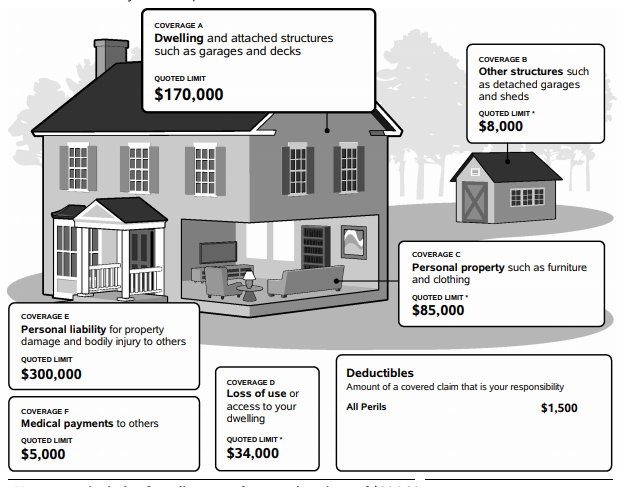
Dwelling — this is the part of your policy that covers the dwelling. The cost to replace your home can fluctuate from time to time. This can vary due to the cost of raw material and labor to rebuild your home.
Other Structures — this covers most structures on your property that are not permanently attached to your house. This could include fencing, driveways, sidewalks, and detached buildings like sheds and garages. Furthermore, this coverage is 10% of your Dwelling limit but it can be increased.
Personal Property — this covers belongings like clothing, furniture, electronics, and appliances. Basically anything that would fall out of your house if you turned it upside down and shook out the contents.
Loss of Use — this can give coverage for temporary extra expenses you may have because your insured home is unlivable after a loss your policy covers.
Medical Expense —this can provide limited medical expense coverage for guest who gets injured on your property. In certain cases it can coverage injury to others off of your property. In contrast, it does not provide coverage healthcare costs for you or other members of your household.
Family/Personal Liability — this typically provides a set amount of coverage for specific type of injury that you cause to others. This can also provide coverage for damage to others property. When choosing your liability coverage limit, consider things like how much money you make and the things you own
What Does Homeowners Insurance Not Cover?
Homeowners insurance provides broad protection, but it does not cover every type of damage that can happen to a home. New home buyers should review the exclusions and limitations before choosing a policy rather than assuming every loss will be covered.
Common exclusions or limitations may include:
- Flooding: Standard homeowners policies generally exclude damage caused by rising surface water. Flood insurance normally requires a separate policy.
- Earth movement: Earthquakes, landslides, sinkholes and other forms of earth movement are commonly excluded. Earthquake protection may be available through an endorsement or a stand-alone policy. Learn more about earthquake insurance in Missouri.
- Sewer or drain backup: Water backing up through a sewer, drain or sump is different from flooding and is commonly excluded unless water-backup coverage is added.
- Wear and tear: Homeowners insurance is not intended to pay for deterioration, aging materials or routine maintenance.
- Neglect: Damage that develops because a known problem was not repaired may not be covered.
- Pests and infestations: Damage caused by termites, rodents, insects, birds or other animals may be excluded.
- Mold: Mold coverage is often limited or excluded. Some policies may provide limited coverage when mold results from a covered loss.
- Mechanical breakdown: Normal failure of heating, cooling, electrical or household equipment is generally not covered unless equipment-breakdown coverage is added.
- Intentional damage: A policy will not cover damage intentionally caused by an insured person.
- Government action, war and nuclear hazards: These are standard exclusions in most homeowners policies.
- Certain high-value belongings: Jewelry, firearms, collectibles, fine art and similar property may have special coverage limits unless they are separately scheduled.
Some coverage gaps can be addressed with an endorsement, while others require a separate policy. Available options may include flood insurance, earthquake insurance, water-backup coverage, equipment-breakdown coverage, service-line coverage and scheduled personal-property coverage.
Before closing on a home, ask your insurance agent to explain the policy’s exclusions, deductibles and optional endorsements. Understanding what is not covered can be just as important as knowing what is included.
Understanding Homeowners Insurance Deductibles
A deductible is the amount you are responsible for paying toward a covered claim before the insurance company pays its portion.
Traditionally, many homeowners policies used a single flat deductible, such as $1,000 or $1,500, for most covered losses. Some policies still work this way. However, many insurance companies now apply a separate wind and hail deductible, particularly in states such as Missouri, Arkansas, Kansas, Oklahoma and Texas, where severe storms are common.
A policy may therefore have two deductibles:
- Other-perils deductible: A flat amount, such as $1,000 or $2,500, that may apply to covered losses such as fire, theft or certain types of water damage.
- Wind and hail deductible: A separate flat-dollar or percentage deductible that applies to covered damage caused by wind or hail.
A percentage deductible is calculated from the dwelling coverage limit shown on your policy. It is not based on the amount of damage, the home’s purchase price or the remaining mortgage balance.
Percentage deductible example
- Dwelling coverage limit: $500,000
- Wind and hail deductible: 1%
- Calculation: $500,000 × 1% = $5,000
- Your deductible for a covered wind or hail claim: $5,000
If the home had a 2% wind and hail deductible, the deductible would be $10,000.
Deductibles generally apply to each claim. A higher deductible may reduce the policy premium, but it also increases the amount you must pay after a loss. New home buyers should review the actual dollar amount of every deductible—not just the percentage—before selecting a policy.